How to start buhurt: from your first practice to your first tournament

Updated 8 min readBeginner

Contents
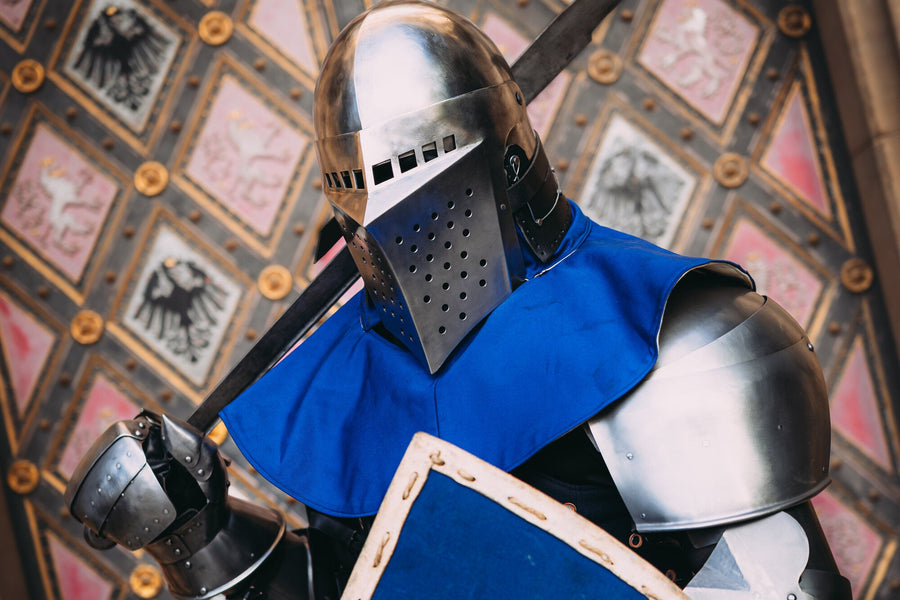
You've seen the videos. Five guys in steel smashing into five other guys, and some part of you wants to be in there. Good. You don't need a martial arts background, your own armor or a lot of money to start. You need a club and the nerve to show up.
I'm Jan Kutnar, Pidel to everyone in the scene. I fight for the Czech national team and build tournament armor in our Prague forge, and I've watched a lot of people walk into their first practice. This is what I'd tell you before yours. If you want the rules, formats and history first, read What is buhurt?
Do you need a fighting background?
No. It's a plus, but you generally don't need one. Some people come from Muay Thai, MMA, judo or grappling. But I've also trained with swimmers, hockey players, rugby and American football players, graphic designers, and IT guys who literally got up from the keyboard.
One of them was a classic nerd in glasses. He put the armor on, ran into the lists and went at it with so much heart that he wiped out guys a generation younger. Fitness you can build. What you can't fake is the switch in your head: accepting that the hit is coming and going forward anyway.
There are no weight classes in team fights, which sounds scary when you weigh 70 kg and the guy across from you weighs 140. In practice the armor evens things out. Lighter fighters are faster, and with leverage and good wrestling they put big guys on the floor all the time.
The other thing you need is to think as a team. Buhurt isn't an ego show. It's chess in armor, and saving a teammate who's pinned two on one is almost always worth more than going for your own takedown.
Find a club
Buhurt is still a small sport, but you'll find it almost everywhere in Europe. When we mapped teams across Europe this summer, we counted roughly 190 of them in 27 countries. Take that as a rough picture, not a census. Teams come and go, and not everyone registers anywhere.
- France is in a league of its own, with around 70 teams and its own federation, the Fédération Française de Béhourd.
- Germany, Spain and the UK have around 15 teams each, Italy and Poland about 10.
- Smaller scenes with a handful of teams each: the Czech Republic, Finland, Portugal, Switzerland, the Netherlands, Belgium, Austria, Denmark, Hungary, Ireland and others.
- Women's teams aren't rare anymore. Roughly one team in seven is a women's team, and the UK and France have the most.
To find yours, start with the team registry on the Buhurt International website, which you can browse by country. Most countries also have a national team or federation that knows every club. And search Instagram for “buhurt” plus your city, most teams recruit there. I fight for the Prague Trolls in Prague. If you can't find anyone near you, message me on Instagram (@the_pidel) and I'll try to point you somewhere.
And don't wait until you're “in shape”. Nobody is when they start.
What training looks like
Most clubs train two or three times a week. A typical progression goes like this:
- Fitness and technique without armor. Wrestling, clinches, head control, covering up, falling safely. Normal sportswear.
- Hitting the dummy. A dummy made of stacked tires that you can hit at full power with an axe, a falchion or a shield. This is where your wrists and forearms get strong.
- Padded weapons. Sparring with soft weapons, so you learn to hit and cover before steel gets involved.
- Armored training. Moving in full kit, getting used to the helmet and managing your breathing.
The hardest part isn't the guy with the axe. It's heat. In a thick gambeson and a closed helmet your body heats up fast, and keeping a cool head when you're out of breath is the real skill. The first seconds in a helmet can feel claustrophobic too. That passes with time in training.
From first practice to first tournament
When I started, it took a newcomer a year or two to get to a tournament, because you had to wait for armor made to order. Not anymore. Most clubs keep loaner armor, so you don't have to spend anything to find out whether this is your sport.
Train regularly, get used to moving in a helmet, show you're safe for the people around you, and you can be in your first sparring or a local tournament within one to three months of your first practice.
Gear: what you need and what it costs
For the first practices: sportswear and water. Everything else the club lends you. Once you're staying, you start buying your own:
| Must-have before you fight in your own kit | Nice to have, can wait |
|---|---|
| Helmet | Padded weapons for training |
| Gambeson and padded trousers | Sports base layer |
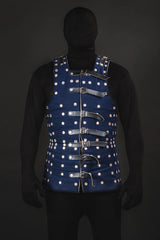
| Body armor, usually a brigandine | Team tabard in club colors |
| Gauntlets | Spare weapons |
| Arm and leg armor | Braces and tape |
| Spine protector |
The spine protector is there for a reason. For a long time I didn't wear one, because it limits how I move. Then at a tournament three Americans got hold of me at once. If I hadn't happened to have it on that day, I'm not sure I'd be writing this. Protecting your health isn't something to be embarrassed about.
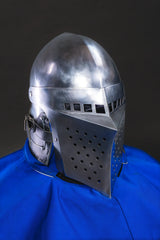
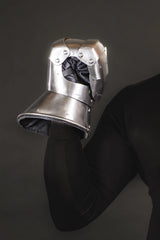
Buy the helmet first. It's the one piece that has to fit you and nobody else, and you should never save money on it. Gauntlets come second, because hands are the most common injury in buhurt.
A full kit of hardened steel is not cheap. Ours, helmet to sabatons, weighs 35.9 kg and costs €5,592, without the gambeson and weapons. Used kits go for roughly €1,200 to €2,900. The good news: steel holds its value. There are few armor workshops and a lot of fighters waiting for kit, and I've seen a set bought for 100,000 CZK sell after five years of fighting for 92,000. You can buy piece by piece too. We open a new drop on the 1st of every month and ship on the 28th.
 Buhurt helmet
 Gauntlets
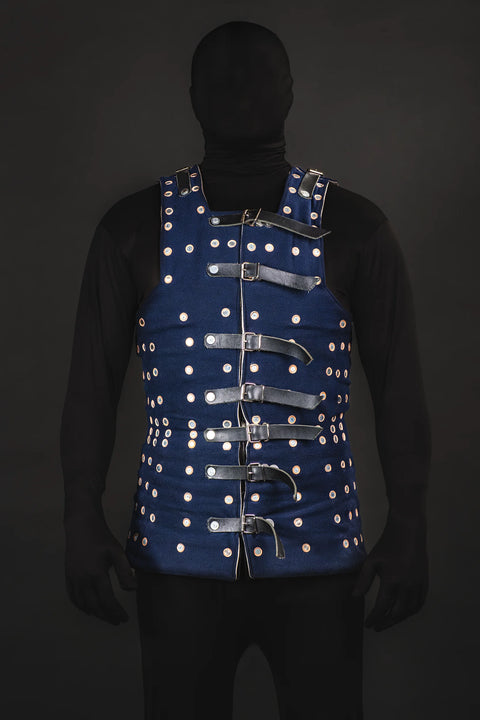 Brigandine
Which weapons to start with
None. For your first practices you don't buy anything, you learn on padded weapons. Once you move to steel, the usual choices are:
- Falchion. A heavy one-handed chopping sword, we call it the shovel. The most common weapon in both duels and 5 vs 5.
- One-handed axe. Fast, and great for hooking a shield away or hitting from the clinch.
- Punch shield or buckler. Less for blocking, more for hitting. Uppercuts and straight punches with a steel rim.
- Two-handed axe or halberd. My favorite. Long reach and enough weight to break the other team's line.
Every weapon is blunt and thrusting is banned, so nothing can go through the helmet's visor. Marshals check weapons before every tournament. Flails and war hammers are banned because they wreck plates and cause serious injuries.
What beginners underestimate
With good gear and the rules followed, serious injuries are rarer than you'd think. These are the things new fighters get wrong most often:
- Heat and water. In summer you can collapse from overheating. Drink, and take electrolytes.
- Helmet fit. It has to sit firmly, with thick padding. Your head is the only one you have.
- Knees and spine. Wear knee protection and a spine protector. The rules also ban hits to the back of the knee, where the tendons are unprotected.
- Breathing in the helmet. Get used to it gradually, in training, not at your first tournament.
- Your own ego. If a teammate is being swarmed two on one, you go and help him. Right now.
It's growing fast
Buhurt is booming in the West. In the US new teams pop up all the time, one club in California went from 4 members to 40 in a few months. In Europe, France has by far the biggest scene, followed by Germany, Spain, the UK and Italy. You're not too late, you're early.
Before you form an opinion from the couch, get up, come to a practice and try it for yourself.
Quick answers
Do I need martial arts experience to start buhurt? No. It helps, but plenty of fighters started with none.
How often do buhurt clubs train? Usually two or three times a week.
How long until my first tournament? With regular training and club loaner armor, one to three months.
How much does it cost to start buhurt? Almost nothing at first, clubs lend armor. A new full kit of your own is around €5,600 for the steel, used ones start at roughly €1,200.
Are there weight classes in buhurt? Not in team fights. The armor evens things out more than you'd expect.