What is buhurt? A beginner's guide from a fighter

Updated 10 min readBeginner

Contents
Buhurt is a full-contact team sport fought in real steel armor with blunt steel weapons. Two teams go at each other inside a fenced arena, and you're out the moment you touch the ground with a third point of support. No choreography. No points for style.
I'm Jan Kutnar, though in the scene everyone calls me Pidel. I fight for the Czech national team at world championships, where we've finished third. I also build tournament armor for a living, so I see the sport from both sides of the visor. This is roughly what I tell people who show up to their first practice.

MMA in steel, basically
Shortest explanation I have: MMA or Muay Thai, in heavy steel armor, with a team. Hits are real and at full power. The aggression is very controlled though, and it stays inside the lists (the fenced arena).
People mix it up with stage combat, reenactment and HEMA. Stage combat is rehearsed for an audience; nothing in buhurt is. Reenactors replay history, and while our armor has to look plausible, nobody plays a character. HEMA (historical European martial arts) reconstructs fencing from old manuals, usually in lighter gear and scored on clean hits. In buhurt you mostly try to put people on the floor.
The crowd at a buhurt club is a strange mix. Former rugby players, swimmers, powerlifters, and IT guys who finally got up from the computer. Armor evens things out more than you'd expect. A 70 kg fighter who understands leverage and timing can throw someone much bigger and heavier.
Where it comes from
The name goes back to the Old French béhourd (pardon my French), a word for medieval tournament games. Those were mostly group fights on horseback, often with blunt weapons or sticks. Firearms killed them off. Once guns could punch through plate, a knight in full armor stopped making sense on the battlefield, and over the 16th century the tournaments that trained him went too.
The modern sport is young. In the late 1990s, enthusiasts in Russia, Belarus and Ukraine started meeting on football pitches in armor that honestly wasn't built for it. The first Battle of the Nations took place in 2010 at Khotyn fortress in Ukraine. In 2013 part of the community split off and founded the IMCF, which still holds a world championship every year. After Russia invaded Ukraine in 2022, Battle of the Nations was cancelled and never came back. Most of its former federations regrouped as what is now Buhurt International, and Russian teams run their own events.
How you win a fight
In the team categories nobody counts hits. You win when everyone on the other team is down.
A fighter is out once they touch the ground with a third point of support. Two feet are fine. Add a hand, a knee, your backside or your shield, and you're finished for the round. Stepping out of the lists counts too. And once you're down, you stay down: no getting back up, no grabbing ankles from the floor.
That rule makes historical sense, by the way. A knight lying on the ground in a real battle didn't have long.
What you can't do under the HMBIA rules (written for Battle of the Nations; today's federations use very similar ones):
- thrust or stab (only cuts and blunt strikes are allowed)
- hit the feet, the back of the knee, the groin or the back of the neck
- hit someone who's already down
- use joint locks, twisting holds, chokes or neck holds
- punch someone in the face with a bare fist
Before every fight, marshals check everyone's kit. Weapon edges have to be at least 2 mm thick and rounded off, weapons have weight limits, and the armor has to cover what the rules require. Federations differ in the details, so read the rules of the tournament you're entering, not a blog post. This one included.
The formats
| Format | Who fights | What it's like |
|---|---|---|
| 5 vs 5 | 5 per team, up to 3 reserves | The main event. Fast and tactical, and where most club fighters start |
| 3 vs 3 | 3 per team | A smaller team format at some events |
| Mass fights | 12 to 150 per side (12 vs 12, 16 vs 16, 21 vs 21, 30 vs 30, 150 vs 150) | Line battles at the big festivals, lots of pushing and hooking |
| Profight | 1 vs 1 | Armored MMA: strikes, kicks, throws, 3 rounds of 90 seconds |
| Duels | 1 vs 1 | Scored on hits, by weapon set: sword and shield, sword and buckler, longsword, polearm |
Why 5 vs 5 is about your teammates
Buhurt is the only combat sport I know where ganging up is part of the game. Pin someone against the fence, a teammate jumps in, and suddenly it's two or three on one. That's the power play. The catch is that the other team can do exactly the same to you, and they will, the second you overcommit.
It took us years to really learn this one: saving a teammate who's pinned is almost always worth more than chasing your own knockdown. Go hunting for a nice takedown, your teammate goes down behind you, and the whole team folds.
A typical five has roughly three kinds of jobs. Heavier fighters pin opponents to the fence and soak up pressure. Fighters with longer weapons go around the side and hit whatever's exposed. And there's the midfielder (in Czech we say středař), who reads the fight and runs to whoever is about to get swarmed.
What you actually wear
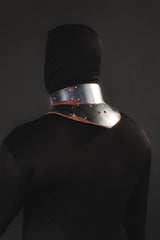
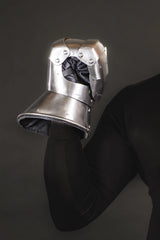
Three layers. A sports base layer against the skin for sweat. Then a gambeson, a thick quilted jacket with padded trousers. The rules require padding under the steel, and after your first axe hit you'll understand why. On top of that comes hardened steel: helmet, gorget, body armor, arms, gauntlets and legs.
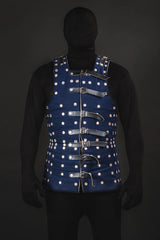
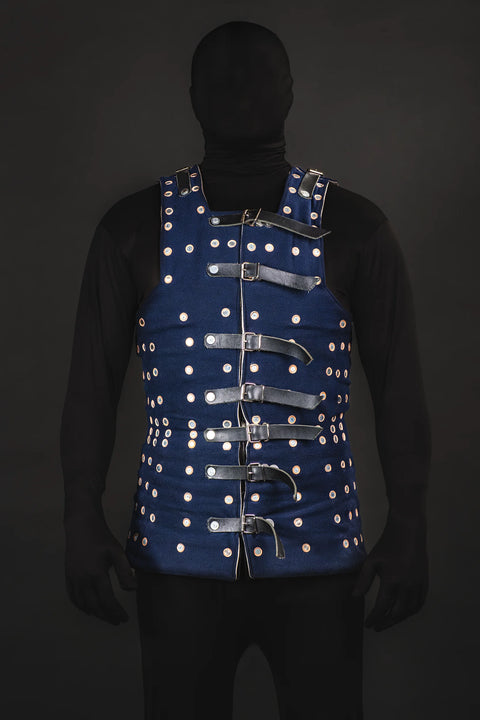
For the body most people wear a brigandine, a fabric or leather jacket with overlapping steel plates riveted inside. It moves with you far better than a solid breastplate. In our workshop every plate is cut, hardened, painted against rust and riveted in by hand. Before that we grind every edge so it can't chew through the gambeson.
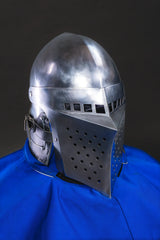
The helmet is the one piece I'd never save money on. The HMBIA minimum is the equivalent of 2 mm steel, with face protection, padding inside and a chin strap. I wouldn't go below 2.5 mm. My heaviest helmet is about 12 kg and my full kit is 52 kg, which is the heavy end. When someone hits a well-fitted helmet with a two-handed axe, it rings like a bell and shifts a little, and most of the time you're fine, as long as your neck is trained and the padding actually fits you.
 Buhurt helmet
 Gorget
 Gauntlets
Some numbers to give you a feel for it:
| Typical | Source | |
|---|---|---|
| Helmet steel | 2 mm minimum by the rules, I'd go 2.5 mm, often 3 mm on the dome | HMBIA rules, Medieval Extreme, my own experience |
| Helmet weight | about 7 to 12 kg | Medieval Extreme, my own helmet |
| Full kit | 20 to 52 kg, around 30 kg is typical, mine is 52 kg | ABC News, Lidé a Země, my own experience |
| Weapon edge | at least 2 mm thick, rounded | HMBIA rules |
| One-handed sword or falchion | 1.7 kg max | HMBIA rules |
Weapons are mostly one-handed: falchions (we call them lopata, the shovel), one-handed axes that are great for hooking a shield away, maces and swords, used with a shield. Then there are polearms such as halberds, around 170 to 200 cm long (that limit comes from Buhurt International's rules). Anything made for thrusting is out.
Is it dangerous?
Yes, it's a full-contact sport and people get hurt. I haven't found a proper injury study on buhurt yet, which is a shame. The closest thing is an informal 2022 survey of 57 fighters, mostly from the US: hands and fingers were the most common injury (18 reports) and concussions came up 10 times. Joint injuries from falls came up a lot too.
What we see from the workshop side: most injury problems come down to how the kit fits, above all the helmet and gauntlets. A helmet that wobbles, gauntlets with gaps. Those are the pieces worth having made to fit you. And no, the weapons aren't sharp. We all have to be at work on Monday.
What it costs
The numbers you'll find are all over the place. Czech fighters quoted 20,000 to 60,000 CZK for a set back in 2014, around 70,000 CZK for custom armor in 2022, and English Wikipedia says $2,000 to 3,000 and up for armor and weapons. A full set from us, helmet to sabatons (armored shoes), comes to about €5,600 at today's prices, without the gambeson and weapons.
Most people don't buy it all at once, and you shouldn't either. Train in club loaner gear first and find out whether you love it.
How to start
- Find a club. I fight for the Prague Trolls in Prague. Other Czech clubs include MFC Česká Korouhev, also in Prague, MFC Vysočina, MFC Zlínsko, Mamánci and MFC Ostrava. Elsewhere, start with your national team or federation, or the club lists of IMCF and Buhurt International.
- Start on fitness now. Neck, core, legs and cardio. A 2024 study measured one fighter's heart rate at 193 bpm in a simulated profight (three 90-second rounds).
- Learn to wrestle. Clinches, hip throws, pinning someone against the fence. Most clubs teach this in normal sportswear.
- Hit things. Clubs usually have a dummy made of stacked tires that you can hit at full power with a steel weapon.
- Fight in loaner kit. Most clubs keep a few spare sets.
- Then get your own, measured to you.
And don't wait until you're "in shape". Nobody is when they start. Come to a practice, borrow a helmet and see how it feels.
Quick answers
How do you pronounce buhurt? "BOO-hurt".
Is buhurt real fighting? Yes. Full force, no choreography, blunt but real steel weapons.
How heavy is buhurt armor? Anywhere from 20 to 52 kg. Around 30 kg is typical, and my 52 kg kit is the top end. The helmet alone is about 7 to 12 kg.
Can you get CTE (brain damage from repeated head impacts) from buhurt? As far as I know, nobody has really studied it in buhurt. Concussions do happen, so take helmet fit and padding seriously and don't fight with symptoms.
How is buhurt different from HEMA? HEMA is fencing scored on clean hits. Buhurt is full-contact fighting where you win by putting people on the ground.
Sources
- HMBIA, Rules for buhurt categories v1.0.2
- HMBIA, Regulations for buhurt categories v1.2
- Wikipedia, Armored combat (sport)
- Wikipedia, Battle of the Nations (modern tournament)
- Wikipedia, International Medieval Combat Federation
- Buhurt Australia, weapons (summary of Buhurt International rules)
- Medieval Extreme, bascinet with wolf-rib visor (helmet specs)
- Lidé a Země, interview with Jan Kutnar, 15 Aug 2026 (Czech)
- ABC News, Medieval combat as a sport: this is buhurt, 2022
- Sensors (2024), physiological demands of a buhurt fighter
- Trash Knight Ringo, buhurt injuries survey results, 2022
- E15, interview with Tomáš Gajdošík, 2014 (Czech)
- Blesk, visiting a buhurt training, 2022 (Czech)
- The Pidel, Jan Kutnar's YouTube channel (Czech)